 PortfolioMarksExplorePricing

No credit card · your data is always exportable
Every card gets its own line in the books: cost basis, acquisition date, sales and fees, and the realized and unrealized (Pro) P&L that follow. Bring cards in by scan, search, or a whole set at once. Raw and graded stay apart, and every copy carries where it lives.

Every card is a position: cost basis, acquisition date, sales and fees. Realized P&L, then unrealized P&L, returns and multiples (Pro), marked across the whole book.
See the ledger →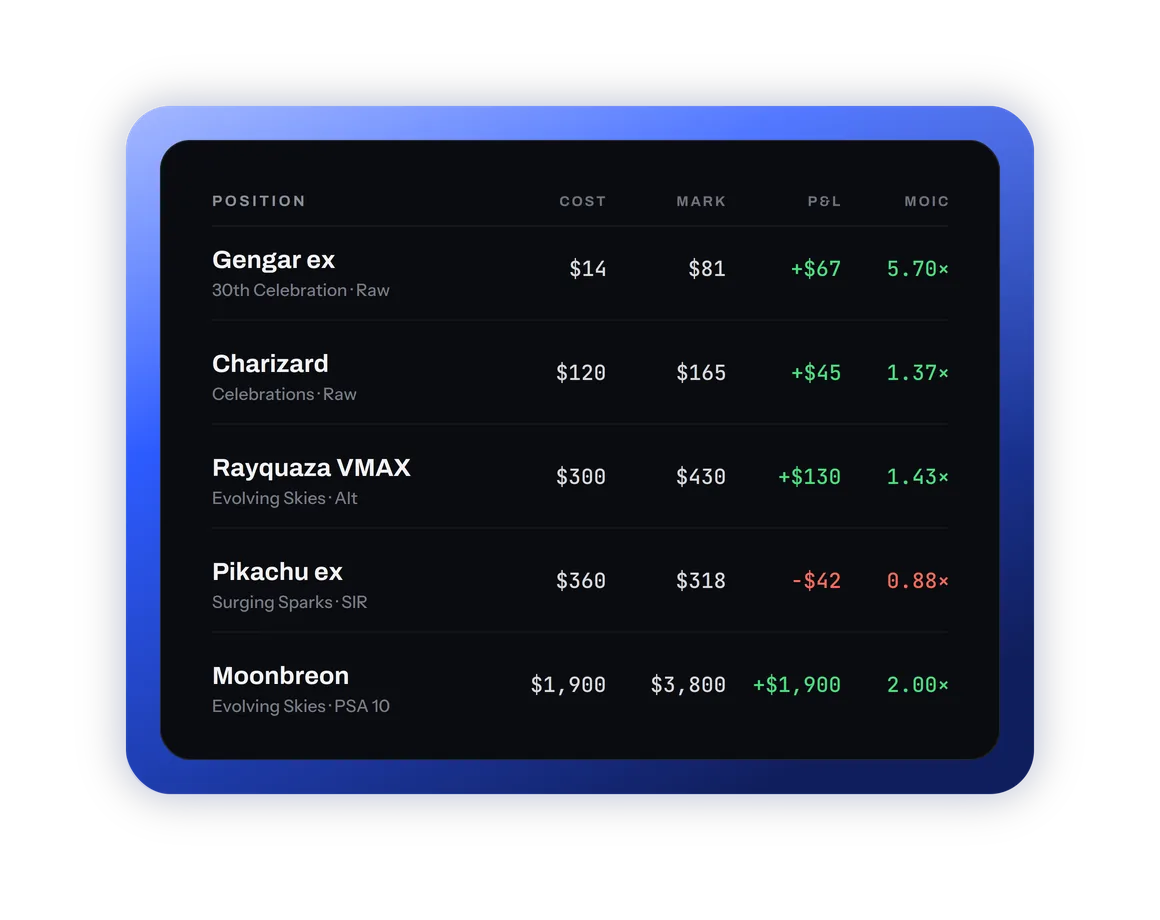
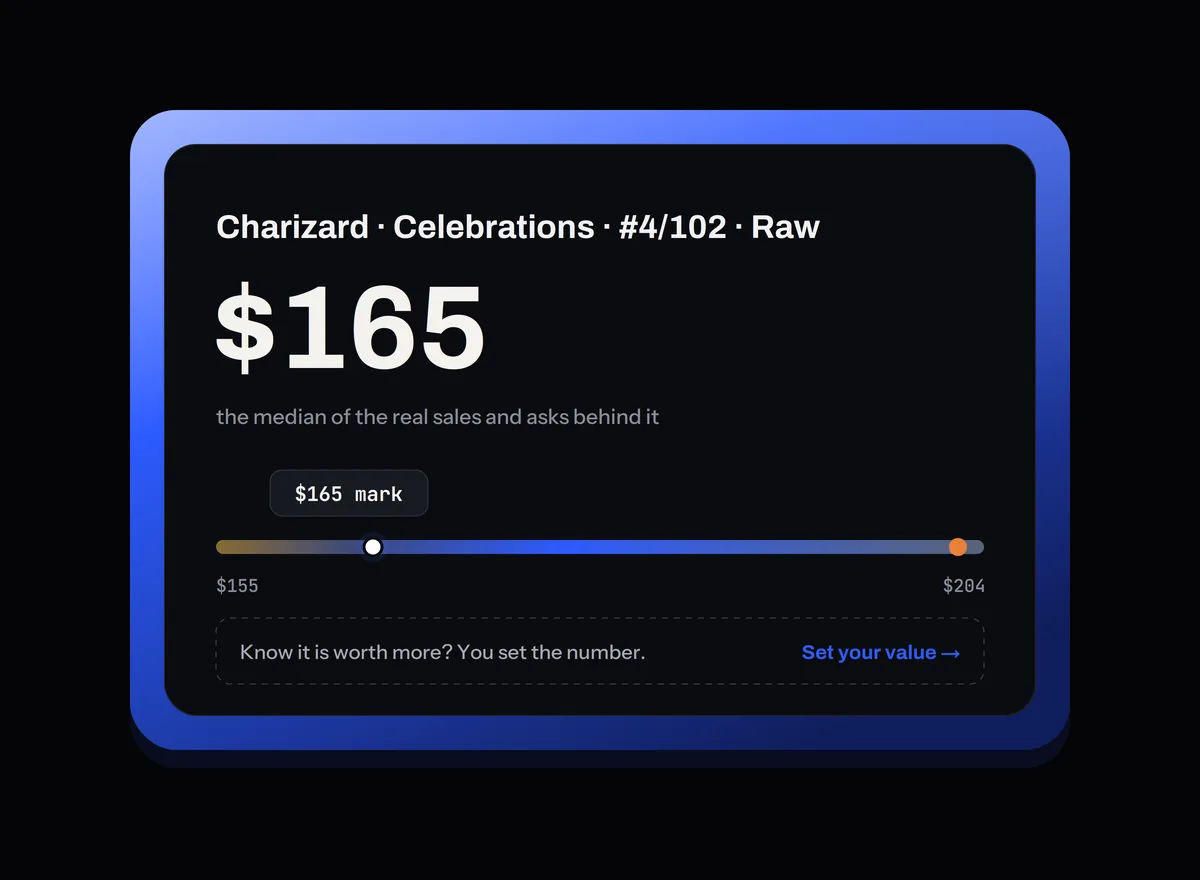
Each mark is built from live asks and sold-market pricing, and published with the range it sits in. Think a mark is wrong? Set your own. Yours governs.
See how the mark works →Over 320,000 cards, every one scanned and searchable, and marked to one standard wherever a market exists to mark against. We would rather cover a few games properly than spread thin across the rest. Pokémon counts twice: Japanese printings are their own catalog, marked on their own sales.
Every catalog is listed under English card names, Japanese Pokémon included. A Japanese Charizard is filed as Charizard, not リザードン, and marked against Japanese sales. Everything else on this list is English printings only.
PullBinder is the system of record for the cards you own: what you paid, what each card marks at, and what you have actually made, kept in one ledger. It records what you paid for every card, what it is worth now, and the gains you have actually made. It runs in your browser on any computer or phone, with nothing to download.
No. PullBinder runs entirely in your browser at pullbinder.com, on a computer or a phone. Nothing to download. Any app store listing using this name is not ours and is not connected to us.
Pokémon (English and Japanese), Magic: The Gathering, Yu-Gi-Oh!, One Piece, Lorcana, Star Wars Unlimited and Flesh and Blood. Cards from any of them can sit in the same book.
Japanese Pokémon, yes: its own catalog, marked against Japanese sales rather than English ones. The other six games are English printings only. Every catalog lists cards under their English names, so a Japanese Charizard is searched and imported as “Charizard”, not リザードン.
Scan them with a phone camera, search for them by name, pull a whole set, or import a CSV. Every card lands as one line with its own cost basis and its own history. See how scanning works.
Starter is free and holds a full book, with a mark on every card we have one for and your cost basis. Pro is $12 a month and adds your returns (unrealized P&L and MOIC), realized gains per sale with short and long-term split, several purchases per card, the year-end tax export, up to 3 portfolios, card locations down to page and slot, the grading calculator, and Page, which answers questions about your book and files copies when you ask. See pricing.
It carries an estimate for each card and the history behind it, so a book shows both what it is worth now and what it has actually returned since you bought it. Those are two different numbers and PullBinder keeps them apart.
Page works on your cards and your portfolio: what you can do with them in the app, you can ask for in plain words. Page does it, and shows you what changed.
Page keeps your book.
PullBinder is the ledger for the cards you own. It runs in your browser, on any computer or phone. Nothing to download, nothing to install.
Built to answer one question: what is this actually worth, and what did it cost me?
No credit card · your data is always exportable
